Mediterranean
المتوسطي
Draft: needs vet review
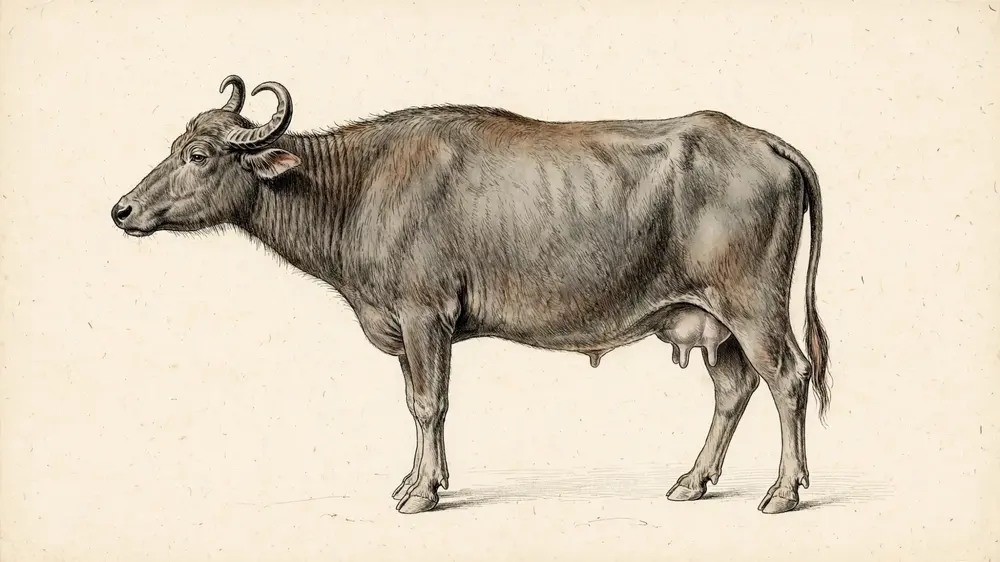
- Type
- Buffalo
- Region
- Italy
- Main use
- Milk
- Known for
- Mozzarella milk
Quick facts
This information is general. For doses and treatment, always ask your vet.
About
Mozzarella milk
Real photos are coming, each with the photographer's name and license.
Benefits & uses
Milk
Milk
Food
Berseem, straw and silage plus concentrate. Give water or deep shade to stay cool.
Common vaccines
FMD, haemorrhagic septicaemia, lumpy skin disease, brucellosis.
Draft: needs vet review
Water and general notes: Buffalo are more affected by heat than cattle because their skin is dark and their sweat glands are few: they need shade, water spraying, or dipping in the summer. Water: 60-120 liters per day.
Feeding by stage and goal
| Stage | Weight / goal (kg) | Intake (% of weight) | Ration protein (%) | Energy TDN (%) | Daily ration example |
|---|---|---|---|---|---|
| Suckling calf (0-3 months) | 30-80 | 18-20 | 75 | Colostrum in the first 6 hours, milk 10% of its body weight, and starter and water from the first week | |
| Post-weaning (3-6 months) | 80-150 | 2.5-3 | 16 | 70 | 2-3 kg concentrate + hay or berseem |
| Veal fattening | 150-400 | 2.2-2.5 | 12-14 | 70 | For a 250 kg calf: 3-4 kg concentrate + straw or silage. Gain 0.7-1 kg daily |
| Heifer rearing (6 months - 2 years) | 150-350 | 2.5 | 12-14 | 60-65 | Berseem or hay + 2-3 kg concentrate. First insemination at around 350 kg |
| Dry buffalo (last 2-3 months) | 500-650 | 1.8-2 | 12 | 60 | Roughage + 2-3 kg concentrate, gradually increase in the last 3 weeks |
| Lactating buffalo | 500-650 | 2.5-3 | 14-16 | 65-70 | For a 10-liter buffalo: 6-7 kg concentrate + 30-40 kg berseem or silage and straw. Buffalo milk is higher in fat, the rule is: 1 kg concentrate for every 1.5-2 liters |
| Breeding bull | 700-800 | 2 | 10-12 | 60 | Roughage + 3 kg concentrate |
Concentrate mixtures (parts per 100 kg)
| Mixture | Yellow corn | Bran | Soybean meal 44% | Cottonseed meal | Molasses | Limestone | Salt | Minerals | Approx. protein |
|---|---|---|---|---|---|---|---|---|---|
| Lactating Buffalo | 45 | 25 | 15 | 8 | 3 | 2 | 1 | 1 | 16 |
For starter and fattening use the cattle mixtures themselves.
Vaccine and care calendar, from birth to sale
| Age / timing | Action |
|---|---|
| Day of birth | Colostrum within 6 hours, navel disinfection, tagging |
| 10-21 days | Drenching against Ascaris (calf worms) according to the vet. This is one of the most important causes of calf mortality |
| 3-4 months | FMD (and a booster after a month), Lumpy Skin Disease |
| 3-6 months | Hemorrhagic Septicemia (and a booster according to the vaccine), and Brucella for females within the government program |
| Every 6 months | FMD, and Hemorrhagic Septicemia before the rainy and humid season |
| Every year | Lumpy Skin Disease |
| Every 3-6 months | Drenching for worms and control of ticks and lice |
| Before sale, slaughter, or selling milk | Make sure the withdrawal period for the last drug has passed |
Common diseases
| Disease | Signs | What to do | Prevention |
|---|---|---|---|
| Hemorrhagic Septicemia | High fever, swelling of the neck and brisket, panting, death within hours. More dangerous for buffalo than cattle | Vet immediately | Vaccination |
| Calf worms (Ascaris) | Diarrhea, butter-like smell, bloating, weakness | Vet | Early drenching in the first 3 weeks |
| Foot-and-Mouth Disease (FMD) | Fever, drooling, sores in the mouth and on hooves | Isolate, vet, report | Vaccination every 6 months |
| Lumpy Skin Disease | Fever and lumps under the skin | Isolate and vet | Vaccination, insect control |
| Heat Stress | Panting, tongue out, reduced feed and milk intake | Cool immediately, and a vet if no improvement | Shade, water spraying, feeding in cooler times |
| Mastitis | Hot and swollen udder, changed milk | Vet, and milk is not sold during the withdrawal period | Hygiene of milking and bedding |
| Blood parasites | Fever, anemia | Vet immediately | Tick control |
Related breeds
Track your Mediterranean herd with Qatee3
Join the waitlistThis information is general. For doses and treatment, always ask your vet.